Internationality
International Mobility Across the Group
Internationality is a structural component of the Rozza Group, reflected in the circulation of students and researchers across institutions and countries. Incoming and outgoing flows show the group as both a destination for research and training and a point of passage within an international scientific ecosystem. Mobility enables methods, perspectives, and expertise to circulate beyond SISSA, extending the group’s scientific connections across borders.
Incoming Attractiveness
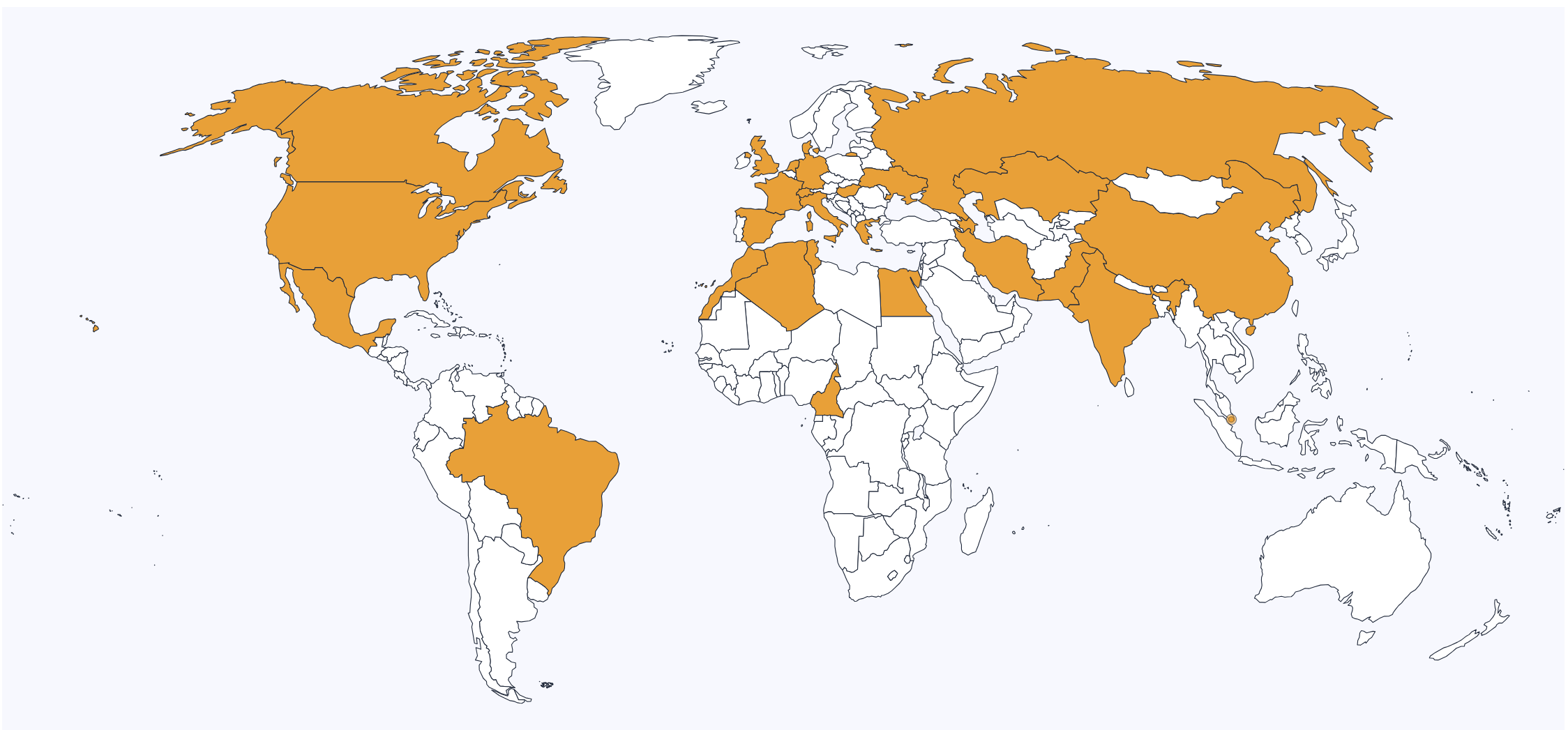
World map adapted from Simplemaps.com. Original map licensed under the MIT License. Copyright © 2020 Pareto Software, LLC DBA Simplemaps.com. Modified for the Rozza Group website.
Algeria Azerbaijan Brazil Cameroon Canada China Denmark Egypt France Germany Greece Hungary India Italy Iran Kazakhstan Mexico Morocco Netherlands Pakistan Russia Singapore Spain Switzerland Tunisia UK Ukraine USA
Outbound Trajectories (Faculty and Post-docs)
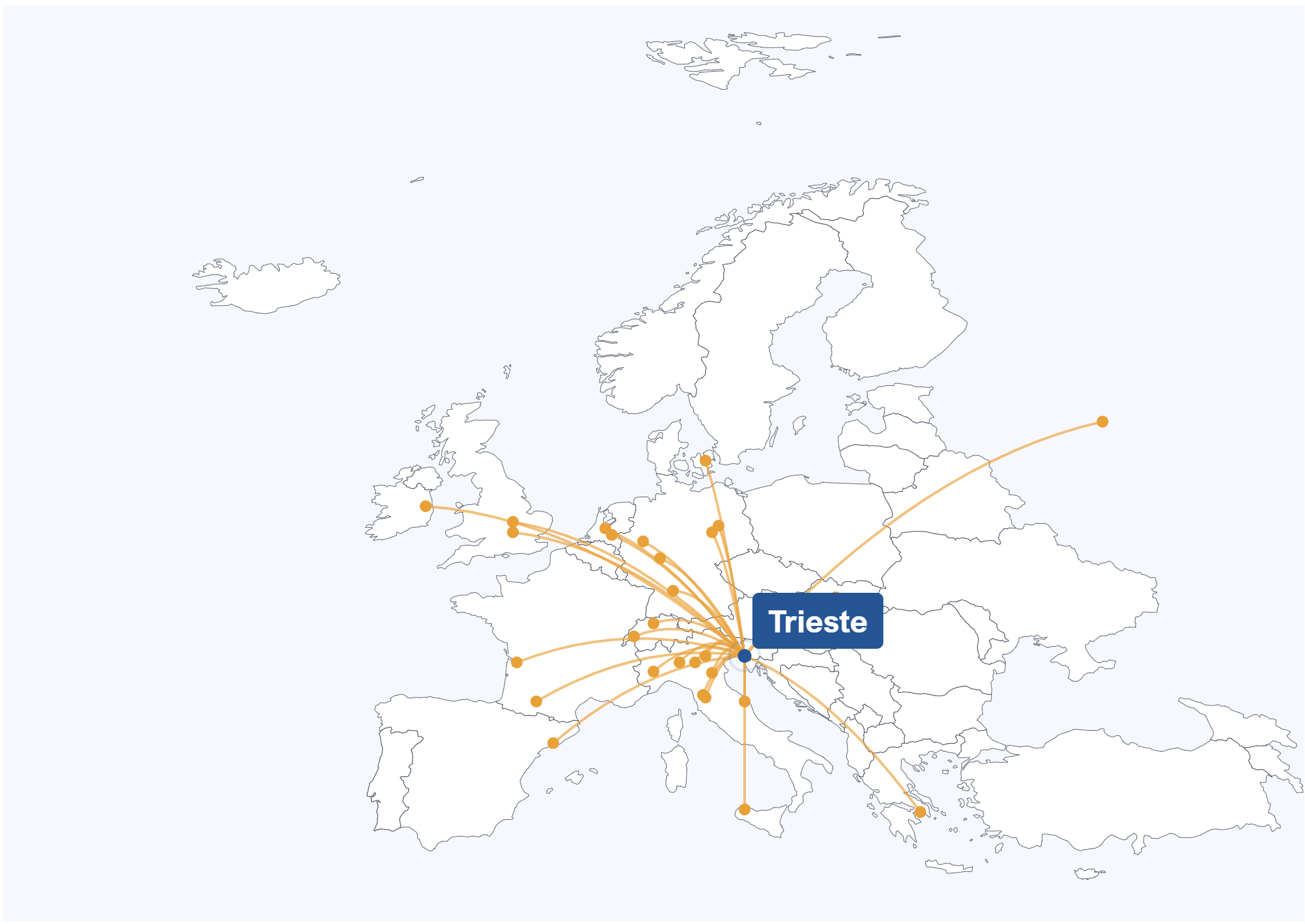
Europe map adapted from Simplemaps.com. Modified for the Rozza Group website.
Ancona Athens Barcelona Berlin Bochum Bologna Bordeaux Brescia Cambridge Copenhagen Dublin Eindhoven Frankfurt Lausanne Leiden London Lucca Milan Moscow Palermo Pisa Potsdam Stuttgart Toulouse Turin Vicenza Wien Zurich
Beyond Europe
Atlanta Austin New York
International Exchange as Research Practice
Internationality is also embedded in the way research training takes place within our group. It is reflected in initiatives that connect students and researchers with institutions, partners, and communities beyond SISSA, making international exchange part of the group’s everyday research environment.
 Doctoral networks
International doctoral networks such as BLESSED, EarthSafe, and ROMSOC, developed within the MSCA framework, support early-career researchers through advanced training and mobility across European institutions. The group also contributes to joint doctoral paths, including a PhD opportunity with the Eindhoven University of Technology.
 International research projects
The Rozza Group is involved in international research projects on mathematical modeling and computational mechanics. Bilateral initiatives such as MIT-FVG connect the group with institutions such as the Massachusetts Institute of Technology, while broader projects such as ARIA support collaborative research across European and transatlantic networks.
 Scientific events
The Rozza Group contributes to international scientific exchange through conferences, thematic workshops, seminar series and advanced training events. Recent examples are SIAM UQ24, SIMAI 2025, YMMOR 2025, and the Fractional Calculus Seminar Series, continued across 2024–2026 with an international online format.